My recent vision has been one of a fully integrated, cooperative biotech ecosystem engaging all small biotech therapeutics companies in Massachusetts, using AI to achieve collective progress together. This vision is for a world that I’ve coined “eutopia”.
I actually do think the outlook for small biotechs in Massachusetts is rosy, but the uncertainty and rapid change that AI will bring to the Bay State in particular may leave some feeling uncertain and uneasy along the way. And layoffs, there will be layoffs.
So, perhaps this original “eutopia” name might lead you to believe that I’m a bit too idealistic about how positive the impact will be of the impending flood of AI technologies, applications and outright social mentions in the thought space in Massachusetts this year. Perhaps I’m overly optimistic, and even though I’m no Nostradamus, I’ll join the club and bless the world with my token “New Years predictions for 2025” as it relates to the AI and biotech scene in 2025. You can put these on the shelf right next to those from consulting firms like Deloitte and Accenture to see how well they age. Hopefully better than my un-watered, neglected house plants.
The Forecast: Torrential AI with a Chance to “Make it Rain” in Biotech
What will we get when we combine AI and biotech, both in ridiculous concentrations, all in the little state of Massachusetts, in 2025? That’s what we’re going to be dealing with. A rapid influx of funding for biotech and AI, the AI Blueprint for MA initiative (the $100M of funding that will fund the party), and I think it is all aligning to set the stage for massive change in the world of Bay State biotechs. Change how? Let me explain.
I’m no chemist either, but this sounds like a formula for an exciting reaction, leading to outcomes ranging from “Good to Great”, as Jim Collins might put it. For those following the AI in biotech space and drinking from the firehose of news in this subject area, it may feel like everyday things speed up from the constant advancement of technology, tools and researchers discovering how to use them for breakthroughs. Excitement, doubters, investments and code in a revolving hype cycle.
“How do I get Mine?” (Or at Least Stay Employed)
This begs the question, where is the opportunity for those of us with biotech backgrounds or working in the industry, and how do we position ourselves to get a piece of the action? Will it be a new business venture? Joining a promising platform company?
Before I get readers too excited for the personal gains that may be realized by some of you as AI makes us all be split into a category of either millionaires or really educated, unemployed peasants, the opportunity might come more in the form of a life raft, not a bag of gold. The golden opportunity is to evolve with the evolving AI landscape, meaning you get to have a job or find yourself in a position where you are not out-bid by ChatGPT in the competition to do work “efficiently”, at low cost and faster than you can say “Two shakes of a kitten’s whiskers”.
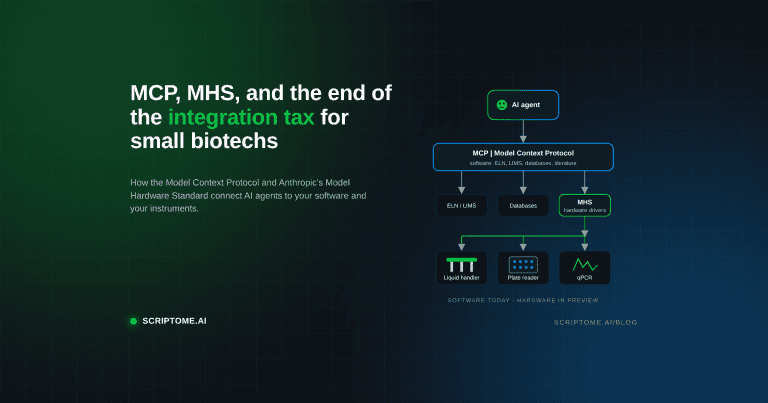
Here’s my next highly original idea. The future of biotech and AI is “agents”. There it is, parroted from the headline predictions of leading tech moguls and co-signed by yours truly. I think the future is in AI agents, not because the smart guys and gals say so, but because that’s what makes sense, given the way things have evolved over the last 6-12 months. AI agents are poised to (using ChatGPT’s favorite word) “revolutionize” the biotech R&D landscape, bringing smart automation and communication to levels that make me want to sing Joy To The World and tear my eyes out at the same time. I mean, what are we all going to do with our time if AI agents can do all of our analyses, communicate diverse, complex information and do it all with a great attitude and smiles on their faces?
My hope is that a reduced caffeine intake needed for “keeping me up to speed with the pace of AI” and a bit of R&R time ensues once AI takes the wheel and does my own work and thinking for me. However, preparing for a scenario where I don’t want to find myself feeling useless to society, and seeing the writing on the wall, I’m betting big on AI agents and the instrumental role they will play in biotech R&D in 2025 and beyond. My game plan is (and yours should be too) to learn to build AI agents.
AI Agents: Easier Than the Timeless Art of Pointing and Grunting
If you think building an AI agent is too hard, that’s likely because you haven’t tried. With the new platforms and tools that let you use natural language to code up anything from scratch without any programming knowledge, you can build one just by describing what it does in natural language. This works even better than the method I used the rest of my life of “pointing my index finger and grunting” when I wanted something done but didn’t have the resolve to do the work myself.
What Will Agents Do, Though?
From what I’ve seen in the last couple months, the AI agent will play a pivotal role of “translator” between the sub-disciplines of the biotech world, facilitating the transfer of complex, domain-specific knowledge from specialist scientists and domain experts to generalists, from generalists to people like me, and from me to even less intelligent living things.
By acting as autonomous entities or components in a system, equipped with both domain knowledge and powerful LLMs that can work in conjunction with maturing knowledge bases, you can theoretically put one of these agents in any scenario, between two people with different levels of domain expertise, and it can figure out a way to translate from one “persona” to the next. When applied at scale across the sciences, the impact of this to R&D will be absolutely….”transformative!!!” However, this means that you and I, as communicators, thinkers and living bodies, will become absolutely worthless to the capitalistic society we live in where efficiency is king. There will be absolutely no way you or I will be able to compete with systems of agents that can do things faster, more precisely and with more source domain knowledge than a 30-year subject matter expert. I think we’re all in for the “Great Humbling of 2025”, an era where we all recognize that “ChatGPT + Agent #4592875” is a machine that can’t be beat, and is better than all of us… at everything.
When AI agents mature and replicate like little well-fed cells to the point where our life science companies are saturated with them, they will surpass our ability to communicate from one especially to the next, from a computational biologist to the wet lab generalist, or from a chemist to a structural biologist, etc. Expertise will become democratized, so the only competitive edge will be the quality and sophistication of the system of agents you can build to do the jobs and analysis the best. That starts with learning to build an agent.
YOU SHOULD LEARN TO BUILD AGENTS.
Learn to build an agent in the very near future, or your career in biotech (or many other industries) will wither on the vine, dry up and eventually you will become obsolete like a house plant that hasn’t been watered in 3 months. (Sorry.) Extreme? Perhaps, but that’s my prediction and I’m sticking to it. If you can’t beat the AI agents, ChatGPT, or the unholy alliances that they will unite to form en masse as we get further into 2025, learn to co-exist with them. AI agents and humans living in perfect harmony.
Eutopia.
Structural Changes Coming to the Massachusetts Biotech Ecosystem
As a company, if you adopt AI agents, on whatever platform becomes convenient or dominant, you will retain your ability to compete in the perpetually accelerating biotech market. It’s a faster race now, and the way to win in drug development is to move faster using smart tools and methods to do so.
My prediction stems from the belief that as specialists in the subdisciplines of biology and science become less in demand, with agents replacing their ability to interpret and communicate expertise in a given area, that will start to losen the fabric that holds together a network of people in R&D, and when that happens, there will be significant cuts to payroll, whether you work at a large or small company.
The good news is that now you know it might be coming, so you can prepare. While there is no single breakaway winner in the biotech/pharma R&D agents game yet, you can probably bet that employees will be building R&D agents on a platforms from one of the big tech/cloud players. Two platforms that I would bet on, and take preparations to familiarize myself with, are Google Agentspace and NVIDIA Blueprints.

Google Agentspace (to be released): A platform on which anyone can build an agent without writing code, by that iconic, 1990s search-engine champion behemoth that just seems to find a way to keep winning. Google has always brought the goods when it comes to company strategy, and I imagine that they will open up Agentspace at just the right time for mass-appeal and adoption. They better hurry though, because NVIDIA is turning lots of heads.
NVIDIA, as a company, is the equivalent to a wild card kid that is also super competent, forward-thinking and vertically integrated. They have opened up NVIDIA Blueprints, which similarly allows for the building of no-code AI agents for anything under the sun. This company moves so fast I can hardly believe it. They are basically a newcomer to the life sciences space, but in just under a year they released the super impressive BioNeMo platform to complement their agents blueprints with molecular computation tools, and NVIDIA in my mind is the current leader in the race to become the go-to biotech/life sciences platform for building AI agents.
If you’re a small (or big) biotech and don’t adopt AI agents, you will almost certainly be out-competed by those companies that are racing to market and choose to opt in.
If you want to work on a plan to weave AI agents into your R&D processes so that you can accelerate your R&D, please reach out to me to get started on a solution sooner rather than later.
And stay tuned to see what is to come at agents.scriptome.ai.