If you run science at a small biotech, you already know the number I am about to describe, even if you have never written it down. It is the hours your team spends moving data by hand between a plate reader, a spreadsheet, an ELN, and a slide deck. It is the six-week wait for a vendor’s professional services team to wire a liquid handler into your scheduler. It is the reason your “automated” workflow still has a postdoc standing next to it. Call it the integration tax. Big pharma pays it with dedicated automation engineering groups. Small biotechs pay it with the time of the exact people they hired to do science.
Two things happened in the last eighteen months that could change the size of that tax. The first is the Model Context Protocol (MCP), which has quietly become the default way AI agents talk to software. The second is the Model Hardware Standard (MHS), which Anthropic previewed on August 27, 2026 as the hardware counterpart: a way for AI agents to operate lab instruments. This post explains what each one actually does, what is real today versus what is still a research preview, and what a small biotech should do about AI lab automation this quarter.
What is the Model Hardware Standard (MHS)?
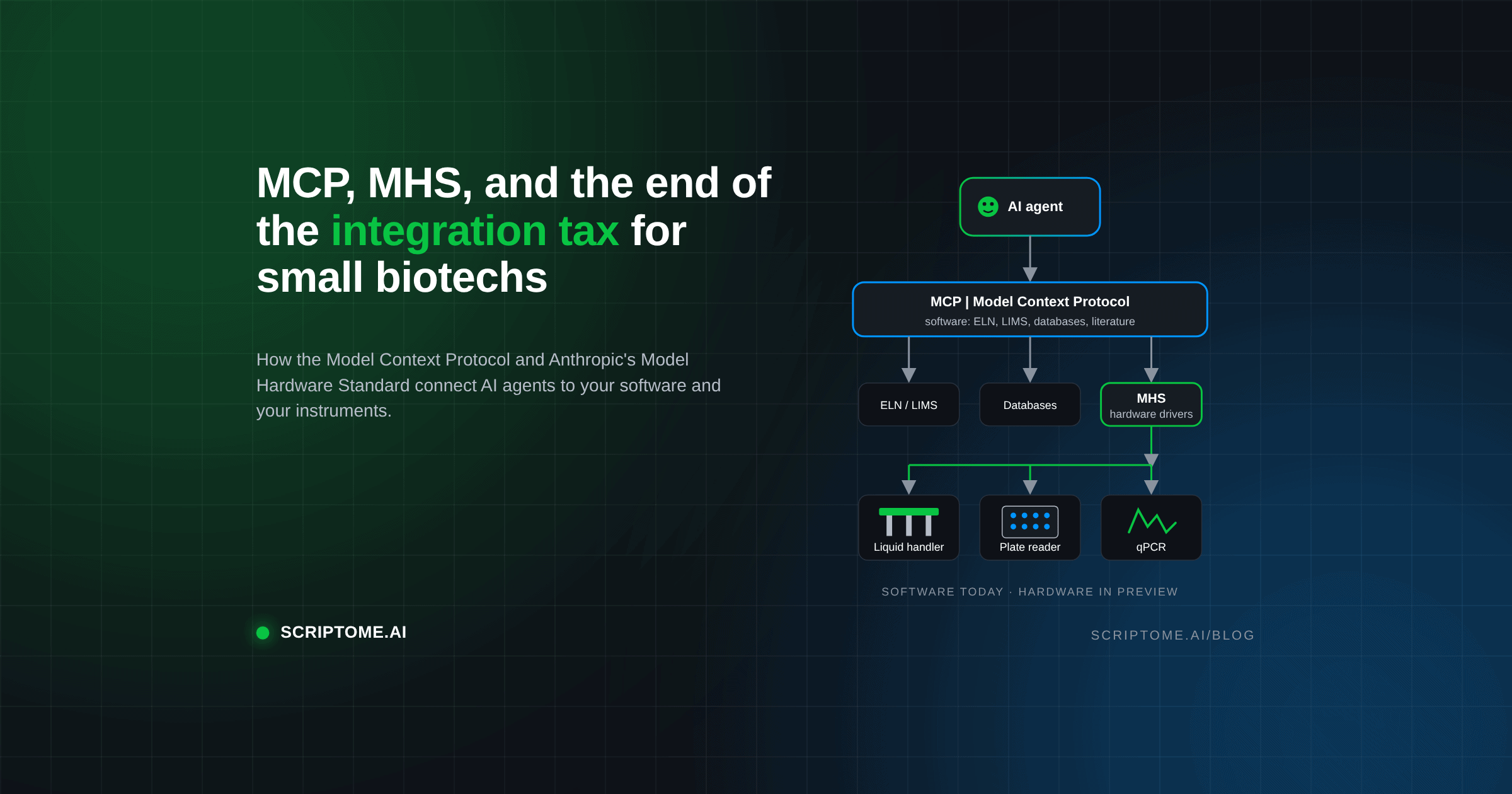
The Model Hardware Standard is Anthropic’s specification for letting AI agents safely operate physical devices, including lab instruments such as liquid handlers, plate readers, thermocyclers, microscopes, and robotic arms. At its heart is a standardized driver: a piece of software that describes a device to the agent, covering what it measures, what can be adjusted, and which safety limits are enforced at the driver level rather than in a prompt. Agents reach an MHS driver through MCP, a command line interface, or plain code, so MHS sits on top of MCP rather than competing with it.
MHS was announced as a research preview on August 27, 2026. Access is by application at modelhardwarestandard.com, and Anthropic says it plans to open-source the standard after completing safety evaluations.
What is the Model Context Protocol (MCP)?
MCP is an open standard that gives AI agents a uniform way to discover and use software tools. The usual analogy is USB: instead of every AI product writing a custom connector for every piece of software, the software exposes an “MCP server” once, and any MCP-capable AI client can plug in. Anthropic launched MCP in November 2024, OpenAI and Google adopted it in 2025, and in December 2025 Anthropic donated it to the Linux Foundation’s Agentic AI Foundation, which means no single company controls it.
A few other terms I will use: an agent is an AI model that takes a sequence of actions to accomplish a goal rather than just answering a question. LIMS and ELN are the laboratory information management system and electronic lab notebook most small biotechs already run (Benchling being the most common in early-stage companies). SiLA 2 is the existing lab automation industry standard for instrument communication, and it matters here because MHS overlaps with it and nobody has yet said publicly how the two relate.
MCP for biotech: what already works today
MCP is the part of this story you can act on today, and the part most small biotechs are underusing.
The clearest example is Benchling. In April 2026 Benchling shipped its own MCP server, with general availability in May, alongside a set of what it calls AI Connectors. In practice this means a scientist can sit in Claude or ChatGPT, ask a question that requires pulling entities, results, and lineage out of Benchling, and get an answer without exporting a CSV. Benchling also built connectors in the other direction to Quilt (for S3 datasets and raw instrument output), Seqera (for Nextflow pipelines), and Elicit (for literature). Ashu Singhal, Benchling’s co-founder, framed the problem plainly: scientists are still moving data between tools by hand, copying results, pasting back analyses, and losing context along the way.
The open-source world is moving just as fast. BioMCP exposes PubMed, ClinicalTrials.gov, and genomic variant databases to any agent. A 2026 paper in PMC called MCP “the unexpected catalyst of a bioinformatics interoperability revolution,” arguing that decades of fragmented formats are finally being standardized because AI agents create demand for it. Cloud vendors have followed: Google’s MCP Toolbox for Databases, Microsoft’s Copilot Studio, and CData’s 350-plus servers mean most of the enterprise software in your stack either has an MCP server today or will within a year. (I covered the broader landscape of AI agents in biotech and pharma earlier this year, and the tools are catalogued in Pavlov-GPS.)
For a company with fifteen scientists and no software team, the practical implication is this. The thing that used to require a custom integration project, such as “join our qPCR results to the sample registry and flag anything outside spec,” is becoming a question you type. The integration is not gone; it has moved from your engineering backlog into a standard the vendor maintains.
Model Hardware Standard results from real labs
MHS is the part of this story to watch and prepare for, not the part to bet the quarter on. But the early results are worth understanding, because they are specifically about the lab instruments a small biotech owns.
Anthropic’s announcement leads with lab work rather than factories. Genentech ran a BCA protein assay coordinated across a liquid handler, a robotic arm, and a plate reader, with Claude tuning fluid-handling parameters on its own. The Baker and Pinglay labs at the University of Washington set up remote qPCR monitoring with real-time analysis of amplification curves and plate handoffs between instruments; the researcher involved said integration took under a week including the time spent writing drivers. Carnegie Mellon built drivers and orchestration for a dose-response serial dilution experiment across three mutually incompatible computer systems in about eight hours, compared with the several weeks a vendor-built setup typically takes, and then ran the experiment roughly three times faster. HHMI Janelia collapsed seven separate vendor programs controlling lasers, stages, cameras, and detectors on a two-photon microscope into a single interface, and reported that adding a new camera went from a multi-day project to a few minutes. Tetsuwan Scientific characterized 9,143 individual dispenses and improved precision predictions 12 to 17 percent beyond the manufacturer’s specification.
Which instrument vendors support MHS?
The vendor list is the part I would pay most attention to. Tecan committed support for its Fluent liquid handlers, QIAGEN for QIAsymphony, Automata for its LINQ platform, MBF Bioscience for ScanImage microscopy software, and Danaher said it is exploring smart instruments and autonomous labs. AWS, Universal Robots, and Doosan Robotics signed on from the robotics side. If even half of those commitments turn into shipped drivers, the instruments sitting in a typical Cambridge or Watertown startup lab will be reachable by an agent without the startup writing a line of driver code.
The caveats: what MHS does not do yet
I want to be careful here, because I think the direction is right and I also think a small company that reads only the press release will make bad decisions.
There is no public specification. No downloadable schema, no versioned spec, no conformance test suite. Keith Robison, who has watched lab automation standards come and go for decades, put it bluntly on his Omics! Omics! blog: if Anthropic wants MHS to be a standard, gatekeeping the spec is a counterproductive path. He also raised the questions I would want answered before spending money: does MHS cover labware geometry, dead volumes, and aspiration heights? Does it cover scheduling and duration estimates, which any real orchestration layer needs? How does it relate to SiLA 2, which instrument makers have already built against? None of that is public yet.
The results are partner projects reported by Anthropic. They are plausible, they come from serious labs, and they have not been independently reproduced.
The model still does not understand physics very well. The most instructive detail in the whole announcement is a failure. During the Genentech assay, a viscous solution foamed, and Claude kept restarting the process in the same vessel with tweaked parameters, which made things worse. It read the error codes fluently and completely misread the physical mechanism behind them. A human had to step in and explain that the foaming was a physical failure, not a software bug. Anthropic says this directly: the models still struggle with physical, chemical, and biological constraints, particularly when troubleshooting errors that call for real-world intuition. Anyone who has run a liquid handler knows that bubbles, clogs, and evaporation are most of what goes wrong.
Model agnosticism is a design claim, not a demonstrated fact. Every published example uses Claude.
And neither MCP nor MHS gives you compliance. If you are doing GLP or GMP work, or anything that will eventually sit in a regulatory filing, the protocol is just the plumbing. Audit trails, identity and access control, data integrity, validation, and change management all live in the systems around the protocol, and they are your responsibility. An agent that can write to your LIMS is also an agent that can write the wrong thing to your LIMS. MCP has known security concerns, including prompt injection and poisoned tools, that were documented within months of its launch.
AI lab automation checklist for small biotechs
Here is how I would sequence it for a company of ten to forty people with no dedicated software team.
Start with software, not hardware. Turn on the MCP server your ELN or LIMS already offers, connect one AI client, and pick a single high-frequency question your scientists answer by hand every week. Measure how long it takes now and how long it takes with the agent. This costs almost nothing and tells you whether your data is clean enough to be useful, which is the real question.
Fix the data before the agent sees it. Every MCP and MHS success story in the announcement came from a lab whose sample registry, plate maps, and results were already structured. If your Benchling is a collection of free-text notebook entries, an agent will produce confident nonsense faster than a human would. The unglamorous work of registration schemas, controlled vocabularies, and consistent naming is the prerequisite for all of this.
Inventory your instruments by interface. Make a list of every instrument, whether it has a programmable interface at all, and whether the vendor is on the MHS commitment list. MHS cannot reach hardware that has no software interface, and Anthropic says so. That list tells you which instruments will get cheaper to integrate first and which ones you should stop waiting on.
Write down your safety envelope now. MHS enforces limits in the driver: maximum temperatures, laser power, plate presence checks. You do not need MHS to decide what those limits should be. A one-page document per instrument listing the parameters an automated system must never exceed is useful today for training humans and will be the raw material for a driver tomorrow.
Treat compliance as a separate workstream. If any of this work touches regulated data, involve whoever owns quality early, and design logging and approval gates before the first agent action, not after.
Apply for the preview only if you have a safe sandbox. If you have an instrument you can afford to misconfigure, a scientist who wants to write drivers, and a workflow that is genuinely bottlenecked on integration, apply. If not, wait for the open-source release and let Tecan and QIAGEN do the driver work.
The bigger picture for lab instrument integration
For most of the history of lab automation, integration has been a luxury good. You needed scale to justify the engineers. That is why fully automated workflows live at Genentech and not at the eight-person company down the street with two liquid handlers and a plate reader, even though the science is often just as good.
MCP has already started to change that on the software side, and it is open, governed by a foundation, and adopted by every major AI vendor. MHS is an early, closed, Claude-only preview of the same idea for hardware, with results that are exciting and a governance model that is not yet a standard in any meaningful sense. The right posture for a small biotech is to build on MCP now, get your data and safety documentation in order, and be ready to move on MHS the moment the spec is public and your vendors ship drivers. The end of the integration tax is coming, first for software and later for hardware. The companies that benefit will be the ones whose data was ready when it did. (If that sounds like the “curious army of autonomous scientists” I wrote about here, it is; this is the plumbing that army needs.)
Frequently asked questions
What is the difference between MCP and the Model Hardware Standard? MCP is an open standard for connecting AI agents to software tools and data sources such as an ELN, a database, or a literature search. The Model Hardware Standard is Anthropic’s newer specification for connecting agents to physical devices such as liquid handlers and plate readers. MHS drivers can be accessed through MCP, so the two are complementary layers rather than competitors.
Is the Model Hardware Standard open source? Not yet. As of September 2026 it is a research preview available by application. Anthropic has said it intends to open-source MHS after completing safety evaluations, but no public specification, schema, or conformance suite has been released.
Which lab instruments work with MHS? The published case studies used liquid handlers, plate readers, robotic arms, qPCR thermocyclers, centrifuges, incubators, and two-photon microscopes. Vendors that have committed support include Tecan (Fluent), QIAGEN (QIAsymphony), Automata (LINQ), MBF Bioscience (ScanImage), and Danaher. Instruments with no programmable interface cannot be reached by MHS.
Does using MCP or MHS make my lab GxP or 21 CFR Part 11 compliant? No. Both are integration layers. Audit trails, access control, validation, and change management have to be implemented in the systems around them.
How does MHS compare to SiLA 2? Nobody has published a direct comparison because the MHS specification is not public. SiLA 2 is the established lab automation communication standard with defined transport protocols; MHS appears to focus on describing devices to AI agents and enforcing safety limits in drivers. Expect this question to be answered once the spec is released.
What should a small biotech do first? Turn on the MCP server in your existing ELN or LIMS, pick one recurring data question, and measure the time saved. Clean data and documented instrument safety limits are the prerequisites for everything else.
If you are a small biotech trying to figure out where to start, this is the work Scriptome.AI does. I am happy to spend thirty minutes looking at your stack and telling you honestly which of these steps is worth your time right now. Get in touch here.
Sources
Anthropic, “Previewing the Model Hardware Standard” (Aug 27, 2026): https://www.anthropic.com/news/model-hardware-standard-research-preview
The Decoder, “Anthropic wants to do for physical hardware what its Model Context Protocol did for software”: https://the-decoder.com/anthropic-wants-to-do-for-physical-hardware-what-its-model-context-protocol-did-for-software/
Keith Robison, Omics! Omics!, “Model Hardware Standard: What Is It? Seriously, That’s What I’m Asking.” (Aug 2026): https://omicsomics.blogspot.com/2026/08/model-hardware-standard-what-is-it.html
Kingy.ai, “Anthropic’s Model Hardware Standard: What MHS Actually Changes”: https://kingy.ai/blog/anthropic-model-hardware-standard-mhs/
Benchling, “Benchling Launches AI Connectors to Power the Data Ecosystem for R&D” (Apr 16, 2026): https://www.benchling.com/news/benchling-launches-ai-connectors-to-power-data-ecosystem
PMC, “Model Context Protocol: The unexpected catalyst of a bioinformatics interoperability revolution”: https://pmc.ncbi.nlm.nih.gov/articles/PMC13528949/
IntuitionLabs, “Model Context Protocol (MCP) in Pharma”: https://intuitionlabs.ai/articles/model-context-protocol-mcp-in-pharma
Wikipedia, “Model Context Protocol”: https://en.wikipedia.org/wiki/Model_Context_Protocol
SiLA Consortium, standards overview: https://sila-standard.com/standards/