You Have a Hypothesis. Here’s How You Might Actually Test It.
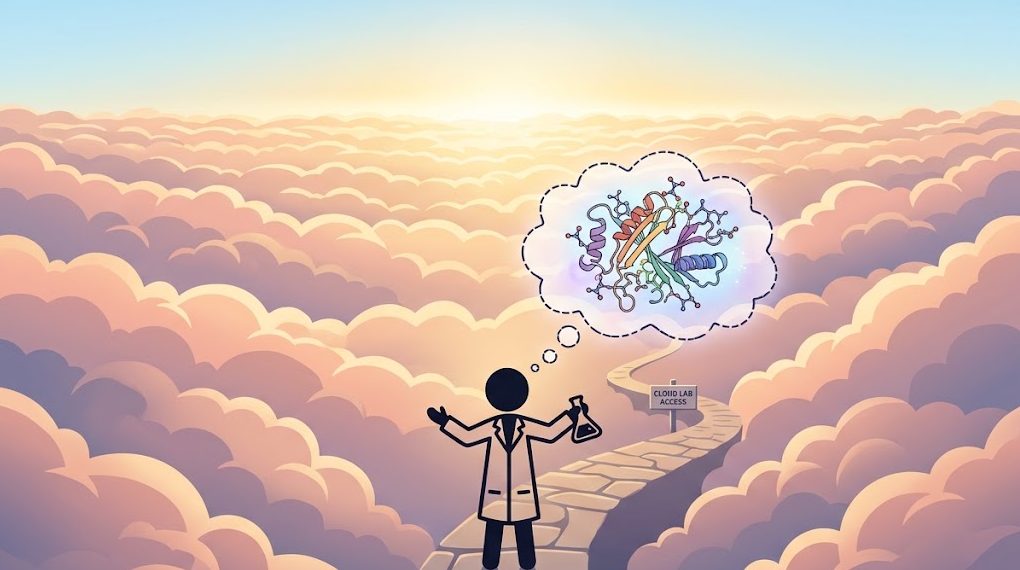
You’re a scientist. You have an idea, a real one, about a protein, a target, a mechanism you think could matter for a disease you care about. Maybe you’re between roles. Maybe you’re at an institution without the infrastructure to chase it. Maybe you just don’t have the several million dollars it’s traditionally taken to find out if you’re right.
For most of modern biotech history, that’s where the idea died. Not because it was wrong. Because testing it required a building, a bench, a robotics budget, and a team, none of which you could get without first convincing someone else your idea was worth funding. The gatekeeper was never insight. It was access.
That’s starting to change, and it’s worth understanding exactly how, because the path forward looks less like “raise money, then build a lab” and more like “test it yourself first, then bring in others once you have something real.”

Stage One: What You Can Do Alone
In July, Northwestern University was awarded $20 million from the National Science Foundation to build the AI-Driven, Rapid, Experimental Automation Machine, known as the DREAM Cloud Lab, the nation’s first publicly accessible, AI powered cloud laboratory dedicated to protein engineering. Here’s what that means in practice: you log in remotely and specify the biological function you want a protein to perform. AI models propose candidate designs. After a biosafety and biosecurity review, robotic systems build and test those proteins automatically. The data comes back, and you iterate again.
Over its four-year award, DREAM expects to synthesize and characterize more than 300,000 proteins and generate roughly 30 million data points, most of which will be released openly. It’s one of 20 inaugural testbeds in NSF’s new Programmable Cloud Laboratory network, backed by roughly $380 million in federal investment, with an explicit goal of democratizing access to infrastructure that used to require an institution behind you.
This is the first stage of the new path: a scientist, alone, with a laptop and a well specified hypothesis, running real experiments that used to require a company.
The Broader Landscape You’d Actually Be Choosing From
DREAM is new and it’s public, but it’s not the only door. If you’re a curious scientist actually trying to do this, here’s roughly what’s out there today, and it’s a smaller field than the hype suggests:
- DREAM Cloud Lab (Northwestern, NSF-funded). Protein engineering specifically. Publicly funded, mission-driven toward open access, and committed to releasing its data and AI models rather than keeping them proprietary. Not yet running at institutional or industry scale, since the facility is only now standing up.
- Ginkgo Cloud Lab. A commercial platform launched in March 2026, giving browser-based access to Ginkgo’s automation infrastructure and more than 70 instruments, with an AI agent called EstiMate that evaluates your protocol for feasibility and price. Broader than DREAM: protein characterization, functional genomics, and ADME profiling for small molecules. You own your data, but you pay for it, and the whole system is built around Ginkgo’s own commercial infrastructure and reagents.
- Emerald Cloud Lab (ECL). The oldest and most established of the group, founded in 2010 and now based in Austin, with 150 to 200-plus instruments and a fully custom experiment-design language. The most general-purpose of the commercial options, spanning chemistry through biotech. Access isn’t casual, though: contracts have reportedly started above $250,000 a year, which puts it out of reach for most individual scientists working alone.
- Strateos. Has actually pivoted away from hosting its own cloud lab toward deploying its automation software on-site at client facilities, following a partnership with Eli Lilly. Worth knowing mainly because it shows the “hosted cloud lab” model isn’t the only bet in this space.
- Arctoris. UK-based and more specialized, focused on pharmacology assays for drug discovery rather than general-purpose automation. Took over Eli Lilly’s former San Diego robotic lab.
Read plainly, that list is a caution against over-claiming: a well-sourced industry analysis this year put it bluntly, there are a handful of real cloud lab providers, not dozens, and most of the commercial ones are priced for companies, not individuals. That’s exactly why DREAM matters. It’s the first entrant explicitly built to be usable by a single curious scientist rather than a funded team, and the first with a mandate to keep its data open rather than proprietary. Whether it can scale to serve real demand is still an open question. But it’s the first credible attempt at removing price as the first gate.
Stage Two: What You Do Once You’re Not Wrong
Say your hypothesis holds up. The data comes back and it’s real. This is where the path stops being solitary.
In a cloud lab world, you can generate meaningful proof of concept before you’ve raised a dollar or hired anyone. That reorders everything downstream. Instead of pitching an idea, you can bring evidence. Instead of convincing someone to bet on your judgment, you can show them your data and ask them to help you scale it. That’s a fundamentally different conversation, and a fundamentally different kind of company gets to start from it.
This is also where the commercial platforms like Ginkgo or Emerald genuinely earn their price tag. Once you know your hypothesis is worth pursuing, you need throughput, faster turnaround, proprietary data protection, and a wider menu of instruments than a single publicly funded testbed can offer. The scientist who started alone on DREAM, using open, subsidized capacity to ask “is this worth pursuing at all,” becomes the founder who moves to a commercial cloud lab, or builds a team around a wet lab of their own, once the answer is yes.
None of this replaces you. If anything, it raises the value of what only you bring: the judgment to know which hypotheses are worth testing in the first place, and the expertise to interpret what comes back critically rather than taking an AI-generated result at face value. The machines can build and test at a scale no human team could match. They still can’t tell you which question is worth asking.
What Still Has to Be Built
A few things still need to mature before this path is smooth for someone actually trying to walk it:
- Regulatory and IP clarity. If you generate data through a federally funded, shared cloud lab and then want to build a company around it, the rules for who owns what still need to be worked out clearly.
- A new kind of scientific literacy. Designing a good hypothesis for an AI-directed, cloud-connected lab is a different skill than running a bench experiment yourself. The scientists who learn it early will have a real head start.
- A clearer on-ramp between stages. Right now the jump from “testing an idea on subsidized public infrastructure” to “scaling it on a commercial platform” isn’t a well worn path yet. The scientists who figure it out first will be writing the playbook for everyone who follows.
The Bigger Picture
DREAM is one grant, at one university, for one class of molecule. But paired with the other 19 PCL testbeds, the existing commercial cloud labs, and the pace of AI progress in protein design, a real pattern is forming: the tools of drug discovery are becoming programmable, remote, and, for the first time, genuinely reachable by one person with a real idea.
You don’t need a building to find out if you’re right anymore. You need a hypothesis worth testing, and a login. What you do after you’re right, that’s still up to you, and increasingly, up to who you choose to bring along.
How Scriptome.AI Is Helping Develop an Autonomous Army of Independent Scientists
Access to infrastructure like DREAM only matters if you know how to use it well. Designing a hypothesis an AI system can act on, interpreting the data that comes back critically, and knowing when a result is worth trusting versus worth re-testing, that’s a different skill than running the bench experiment yourself, and it’s not one most scientists were trained for.
That’s the gap we built AI Upskilling for Bench Scientists to close. Co-taught with Jesse Johnson, the course is a hands-on program designed to take working scientists from AI-curious to AI-capable, so that when the cloud lab is available, they’re ready to use it well from day one. It’s not about replacing scientific judgment. It’s about making sure the judgment you already have translates into this new way of working.
If the future of drug discovery includes an army of independent scientists testing their own hypotheses before they ever raise a dollar, that army needs training as much as it needs infrastructure. Learn more at https://courses.scriptome.ai.